

Press Release
Hyundai E&C Introduces Customized, Hands-On Summer Care Program for Workers
■ Hyundai E&C CSO Visits Gajwa Tech Center for Special Heatwave Inspection and Worker-Participation Campaign
■ Signs MOU with Korean Drug, Delivers Electrolyte Supplements to Prevent Dehydration and Promotes 5 Basic Rules for Heat Illness Prevention
■ Hyundai E&C Mobilizes Full Resources to Safeguard Workers Through Custom Solutions, Smart Tech, and Heightened Awareness
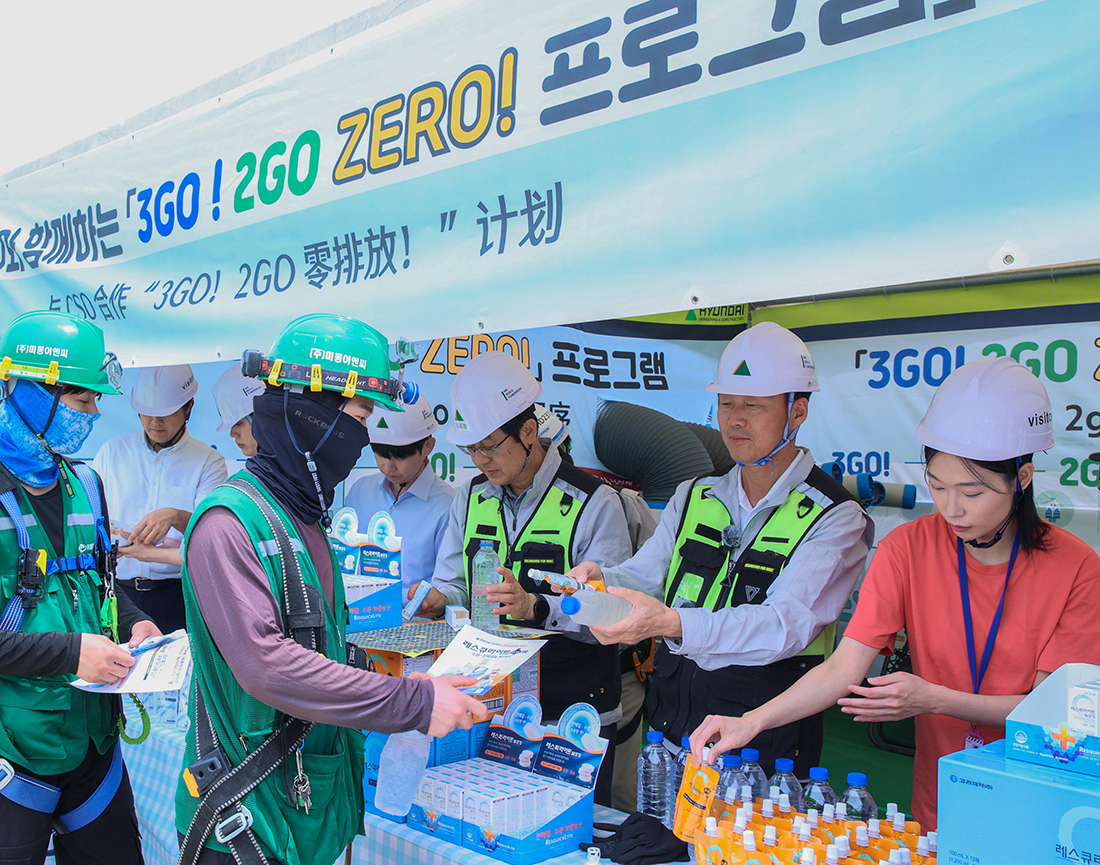
Hyundai E&C Heat-Related Illness Prevention Program
Hyundai E&C announced that it is currently carrying out a "Special Summer Heatwave Site Inspection and Heat-Related Illness Prevention Program" across 121 construction sites nationwide.
On June 1, Shin Jae-jeom, Chief Safety and Health Officer (CSO) of Hyundai E&C, personally visited the Gajwa Tech Center site—a data center in Seo-gu, Incheon—to inspect the facilities and related equipment, and led a campaign distributing cold beverages to approximately 300 workers.
Hyundai E&C implements a heat-related illness prevention program every summer to protect the health and safety of its workers. This year’s program, in particular, reflects the government’s stronger commitment to workplace safety, including the enforcement of heatwave-related provisions under the Occupational Safety and Health Act and the operation of a special task force. A key feature of the program is its focus on worker-centered, customized safety solutions.
First, Hyundai E&C upgraded its existing “3GO! Program” to the “3GO! 2GO ZERO! Program.” It combines the three heat-related illness prevention methods - ▲Drink (hydration), ▲Take shelter (shade), and ▲Cool down (rest) - with the practical measures of ▲Wear (cooling gear) and ▲Call (119), fully incorporating the government’s five major safety guidelines so that workers can easily understand them.
In addition, Hyundai E&C collaborated with Korean Drug, to provide oral rehydration solutions to workers who are vulnerable or sensitive to extreme heat and require immediate electrolyte replenishment. The company is also expanding the distribution of cooling gear, including fan vests for all outdoor workers. To ensure a swift response in emergencies, Hyundai E&C plans to distribute “119 Emergency Call Guide Videos,” produced in 22 languages, to all job sites, enabling foreign workers to respond quickly in critical situations.
Measures to protect workers on the ground have also been significantly strengthened. The company is stepping up monitoring of workers newly assigned to extreme-heat work and is making every effort to prevent heat-related illnesses at the source by introducing wearable body temperature monitoring devices for workers requiring intensive health management.
To ensure sufficient rest for outdoor workers during the peak summer heat, Hyundai E&C is implementing its “Rest Certification Incentive Program” for the first time this year. Under this program, workers receive incentives when they verify that they have taken breaks at designated rest facilities. The program is expected to deliver tangible results by encouraging voluntary participation.
