

Press Release
Hyundai E&C Secures Green Certification for Nanoparticle-Based High-Early-Strength Concrete Technology
■ Approximately 55% reduction in carbon emissions compared with conventional methods… A major achievement following the company’s designation as the first in Korea to receive “New Disaster Safety Technology” certification in the concrete sector
■ Effectiveness demonstrated through application at sites including Section 2 of the Daegok–Sosa Double-Track Railway and Hillstate Dohwa The Terrace
■ Expanding the use of eco-friendly materials, including low-carbon materials and recycled resources… Efforts to achieve carbon neutrality by 2045
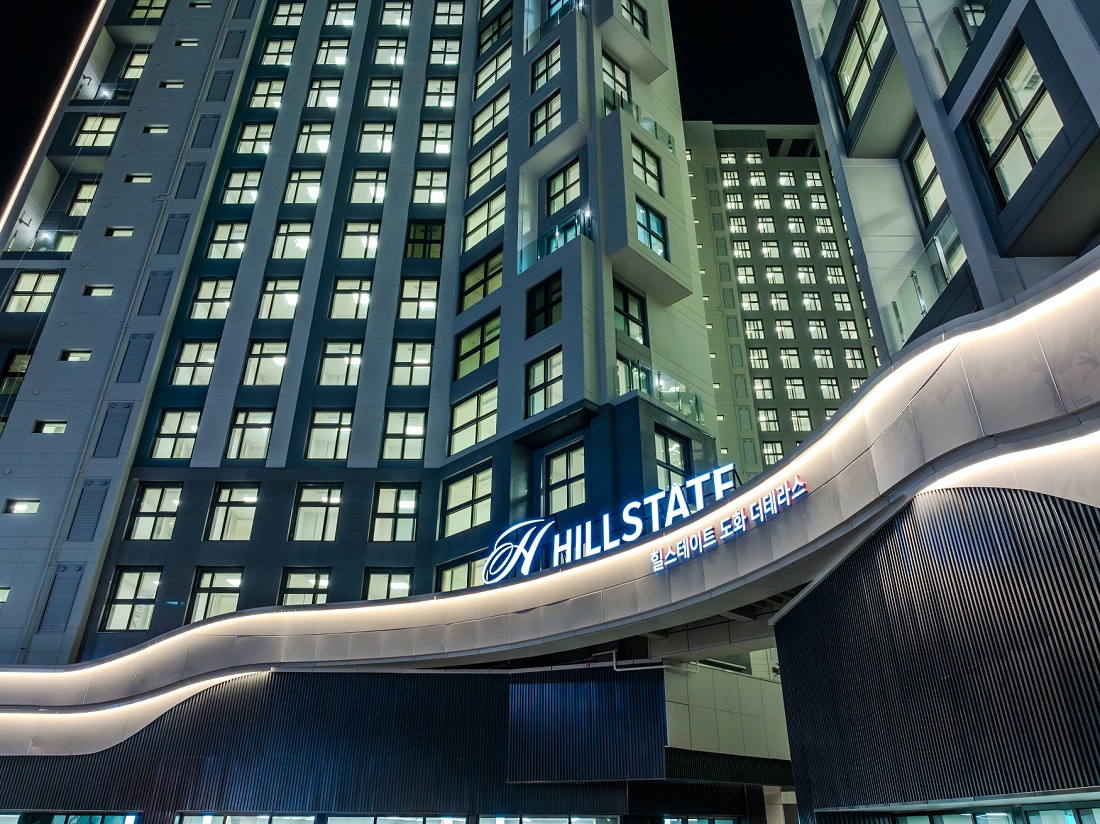
View of Hillstate Dohwa The Terrace, where high-early-strength concrete was applied
Hyundai E&C is accelerating the green transition of the construction industry by expanding the use of low-carbon construction materials and recycled resources.
Hyundai E&C recently announced that it has obtained Green Technology Certification for a “process technology for applying high-early-strength concrete in concrete construction at construction sites when the daily average temperature is 5°C or higher” (hereinafter referred to as the “high-early-strengh concrete technology”), which can dramatically reduce energy consumption during concrete curing.
The Green Technology Certification System is a national certification program jointly administered by nine relevant government ministries, including the Ministry of Land, Infrastructure and Transport, and 11 evaluation agencies, including the Korea Agency for Infrastructure Technology Advancement, pursuant to the 「Framework Act on Low Carbon, Green Growth」. Green Technology Certification is granted to technologies verified to reduce energy and resource consumption and minimize greenhouse gas and pollutant emissions throughout their entire life cycle. In particular, certification is determined through a comprehensive assessment of not only the innovativeness of the technology but also its greenhouse gas reduction effects, contribution to environmental improvement, and commercialization potential.
The high-early-strength concrete technology, jointly developed by the HMG Construction Technology Research Institute and Sampyo, utilizes a C-S-H (calcium silicate hydrate) activator that is ground and formulated at the nanoparticle level. The technology is characterized by its ability to achieve a compressive strength of 5 MPa or higher within 18 to 24 hours without any additional heat supply, provided that the temperature is at least 5°C.
MPa (megapascal): A unit equivalent to 1,000,000 Pa (pascals), the basic unit used to measure the compressive and tensile strength of materials.
With conventional concrete, a construction environment of 10°C or higher is required to achieve a strength of 5 MPa during the winter, and heat must be supplied using fossil fuels for at least two days. However, when high-early-strength concrete is used, a strength of 5 MPa can be achieved within 24 hours as long as the ambient temperature is 5°C or higher, allowing the required performance and quality to be achieved quickly with minimal heat supply.
According to the results of the Green Technology Certification evaluation, the high-early-strength technology was found to reduce carbon emissions by more than 55% and emissions of eight types of process-generated hazardous substances by more than 54% during the construction process compared with conventional concrete (Type I ordinary cement concrete), thereby meeting the evaluation agency’s criteria.
Furthermore, the technology was recognized for its outstanding performance in reducing the risk of collapse during winter construction and became the first concrete technology in Korea to be designated as a New Disaster Safety Technology by the Ministry of the Interior and Safety.
In addition, because it allows for the continued use of existing production plants and construction equipment, it offers excellent cost-effectiveness and on-site applicability. Its excellence has been demonstrated through application at numerous Hyundai E&C sites, including Section 2 of the Daegok–Sosa Double-Track Railway and Hillstate Dohwa The Terrace.
In addition, the HMG Construction Technology Research Institute has also successfully developed a low-carbon blended cement utilizing industrial by-products such as blast furnace slag generated from steelmaking processes and fly ash generated from thermal power plants. This cement has sufficient early strength to enable advance production as a finished product at the plant and not only utilizes recycled materials but also ensures quality. The plan is to apply it to construction sites this year after completing commercialization verification.
An official from Hyundai E&C stated, "Hyundai E&C has declared its commitment to achieving carbon neutrality by 2045, and to realize this goal, we are making all-out efforts to establish fundamental countermeasures aimed at decarbonizing the entire value chain of the construction industry and strengthening our capacity to respond to climate change." The official added, "Hyundai E&C will continue to devote itself to developing environmentally conscious new technologies spanning from construction materials to buildings, striving to build a sustainable construction ecosystem.”
