

Press Release
Hyundai E&C Ushers in the ALL-PC Era for Apartment Housing
■ PC method extended to apartment core areas, including elevator shafts and stairwells… demonstrating seismic performance
■ H-Link connection technology secures constructability and quality… patent pending
■ Following PC Rahmen structure, PC structural walls to drive residential space innovation and accelerate off-site construction (OSC)
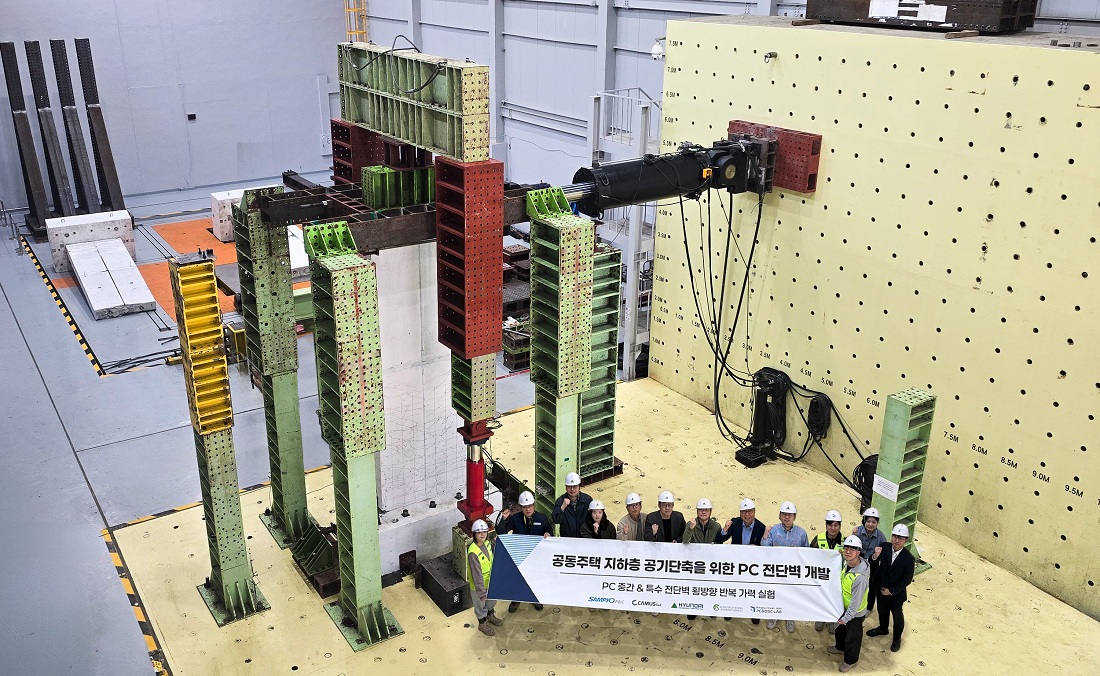
Researchers pose for a photo after completing structural testing of H-PCW technology at the structural testing laboratory of the HMG Construction Technology Research Institute in Mabuk-dong, Yongin, Gyeonggi Province
Hyundai E&C is accelerating its transition to off-site construction by successively securing key structural technologies for apartment buildings.
The Korean builder announced on the 16th that its “PC Structural Wall System with Seismic Performance Ensured through the Application of H-Link Connections” (hereinafter referred to as “H-PCW”) had received certification of conformity from the Architectural Certification Center of the Architectural Institute of Korea (AIK).
The certification is significant as it demonstrates that the “PC (Precast Concrete)” method can be applied even to the core areas of apartment buildings, including elevator shafts and stairwells, which have traditionally relied on the conventional “RC (Reinforced Concrete) method” involving on-site rebar installation, followed by concrete placement and curing, while ensuring seismic performance and safety.
Jointly developed by Hyundai E&C with Sampyo P&C and CAMUS E&C, H-PCW technology uses a looped U-shaped hook rebar, called “H-Link,” to improve ease of construction for vertical connections between PC walls. The technology also improves structural performance, and a patent is pending.
Last year, Hyundai E&C obtained technical certification from the Korea Structural Engineers Association (KSEA) for its “Residential PC Moment-Resisting Frame System”. That system’s beam-column connection technology made column-free, flexible floor plans possible within individual units. With H-PCW, Hyundai E&C has now proven structural safety in the core area as well, making ALL-PC construction of apartment buildings more feasible.
“While OSC offers many advantages, including quality and productivity improvements and reductions in safety accidents and environmental impact, there have been some concerns about structural safety in the apartment building market,” said a Hyundai E&C official. “Because H-PCW technology meets the structural performance requirements of the Korean Design Standards (KDS 41 20 10), we expect it to mark a new turning point in expanding the application of the PC method and revitalizing the OSC market.”
Meanwhile, the HMG Construction Technology Research Institute, the integrated R&D organization of Hyundai E&C and Hyundai Engineering, is expanding its demonstration research on future residential technologies, alongside its structural and construction innovations for apartment buildings such as PC Rahmen structural system and PC structural wall systems. Going forward, the institute plans to concentrate on the technological advancement of its “Hyper-Living” technologies, which include design modifications that separate the structure(support) from interior space (infill) to flexibly accommodate changing lifestyles; “Energy Care” technologies that improve energy efficiency and residential comfort; and the “All Life Care House,” which supports residents’ health and quality of life.
